7 Little Words and More
- 4.7
- Rating
- 1.00M
- Installs
- Free
- Price

 Analysis by App-foxy
I usually know within a week whether a word game deserves a permanent place on my phone or whether it was only interesting because it was new. 7 Little Words made a good first impression because it turns a familiar vocabulary exercise into a compact daily routine. Instead of asking me to build one long word from a rack of letters, it presents short clues and a group of letter chunks that must be combined into the answers. That small change makes each puzzle feel more like deduction than simple recall.
It is a free word game from Blue Ox Family Games, Inc., aimed at Everyone and available on supported devices running at least iOS 10. The game has been around since Aug 9, 2011, which matters here: this is not an app relying only on launch-day curiosity. Its current version is 8.15.2, and its continued presence is reflected in a 4.7 average from around 140 thousand ratings, alongside more than 1 million installs. Those figures do not automatically make it right for me or you, but they suggest that the basic daily-puzzle idea has held up for a substantial audience.
Why the first week feels so easy to keep
The opening appeal is the low commitment. I can pick it up while waiting for coffee, finish a puzzle during a short break, or stop after a single clue without feeling that I have abandoned a large game session. The format gives me a clear beginning and end, so it fits naturally into small gaps rather than demanding a dedicated evening.
You May Also Like

 Blood Strike: 2.5 Anniversary
Blood Strike’s Loadouts Turn Every Drop Into a Tactical Gamble
A close look at Blood Strike’s custom loadouts: how fast access to signature weapons reshapes its battle royale rhythm, rewards preparation, and narrows the gap between fights.

 Pandora - Music & Podcasts
Pandora’s Music Is Easy to Start, but Harder to Recover
Pandora’s strength is its low-effort path from a seed to a station. Its weak spot is how much confidence it asks you to place in connection, setup, and quiet recovery.

 8 Ball Pool
 Is Built on Rivalries, Rematches, and Routine
A close look at the rivalries, rematches, shared routines, and unanswered safety questions that turn a quick pool match into a persistent mobile community.

 Samsung Music
’s Quiet Strength Is Playing What You Already Own
Its reach comes less from spectacle than from dependable access to a personal library. That simplicity is both the app’s strongest retention engine and its ceiling.

 AccuWeather: Weather Radar
AccuWeather Review: A Quick, Clear Forecast for Everyday Decisions
For everyday plans, the best forecast is the one you can understand quickly. AccuWeather makes rain timing, radar, and local conditions easy to act on, with a few trade-offs.

 Hill Climb Racing
Why Hill Climb Racing Still Turns Crashes Into One More Run
A tiny car, a bumpy hill and one more upgrade: Hill Climb Racing keeps resurfacing because its simple chaos makes every near-miss feel personal.
More From Our News Desk



The clue-and-chunk design also creates a satisfying middle ground. A straightforward clue can be solved quickly, but the more interesting moments come when I recognize the answer and then have to assemble it from the available pieces. That second step prevents the game from becoming a basic synonym quiz. I am not only asking, “What word fits?” I am also checking whether the word can be built correctly from the supplied chunks.
During my first sessions, the strongest hook was the way one solved answer could unlock my thinking about another. A clue that initially seemed vague often became clearer after I used a familiar chunk elsewhere. This gives the puzzle a gentle chain reaction: progress comes from vocabulary, but also from rearranging the information already visible on the screen.
The game is especially approachable for people who enjoy crosswords but do not always want a large grid. A crossword can require keeping track of several crossing answers and a broad theme. Here, the smaller presentation feels less intimidating. It is also a better fit than a timed word scramble for anyone who prefers reflection over speed. I never feel pushed to type as quickly as possible, and that makes it suitable for a quiet morning routine.
There is a useful social angle too, even without turning the experience into a competitive event. It is easy to show a clue to someone nearby and discuss possible answers, because the puzzle state is compact and understandable at a glance. I can imagine using it with a family member who likes words but does not play conventional games. The Everyone rating supports that broad accessibility, although younger players will still need enough reading ability to understand the clues.
The best way to approach the opening puzzles
My practical advice is not to attack the hardest-looking clue first. I scan the entire set, identify the answers that seem nearly certain, and use those to reduce the available chunks. Once a few pieces have been committed, the less obvious clues become easier to interpret. This is more effective than staring at one stubborn definition and trying random combinations.
I also try to treat the chunks as evidence rather than decoration. A short piece that could belong to several words is often more useful when I reserve it until another answer becomes clearer. That habit reduces careless guesses and makes the solving process feel deliberate. It is one of the first signs that the game has more depth than its simple screen layout suggests.
Hints can be tempting when I am impatient, but I get more value by waiting until I have tested the obvious possibilities. Using help too early can remove the most rewarding part of the puzzle: the moment when a clue changes from vague to obvious because the remaining letters finally point in one direction. On the other hand, refusing help completely can turn a relaxing habit into a frustrating obligation, so I prefer to use assistance as a way to preserve the routine rather than as a measure of skill.
What changes after the novelty wears off
The important question for a daily word game is not whether the first few sessions are enjoyable. Most well-designed puzzle apps can manage that. The real test is whether I still want to open them after the initial discovery has disappeared. In this case, the recurring value comes from the reliable size of each challenge and the variety of ways a clue can interact with its letter chunks.
Because the game is built around short puzzles, it does not require me to remember a complicated story, maintain a character, or learn a large set of controls. That makes returning unusually frictionless. I can leave it alone for a while and come back without needing a tutorial or a refresher. For a phone game intended to become a habit, that simplicity is a real strength.
At the same time, the same simplicity limits its range. If I want a dramatic campaign, a large progression system, or a strong sense of exploration, this is not where I will find it. The pleasure is in solving the next word set, not in unlocking a new world or changing how the game plays. I see that as a deliberate trade-off rather than a flaw, but it determines who will keep it installed.
Compared with a standard crossword app, this feels more focused and less spatial. Compared with a word-search game, it asks for more interpretation and less visual scanning. Compared with a fast anagram game, it is calmer and more clue-driven. Those distinctions help explain its long-term audience: it suits people who want a repeatable mental exercise, not players looking for constant novelty or reflex-based challenge.
How I would fit it into a normal month
My preferred pattern is to make it a small anchor in the day rather than a task to complete at all costs. I might solve one set with breakfast, return to a difficult clue later, and stop once the session feels satisfying. That approach protects the game from becoming another notification demanding attention. The compact format works best when I choose it, not when I feel pressured to maintain a perfect streak.
It can also work as a reset between demanding activities. After reading emails or concentrating on a long piece of work, a short clue-based puzzle gives my attention a different shape without requiring a major commitment. The useful part is the change of mental gear: I am looking for meanings, testing combinations, and accepting that a wrong guess is easy to revise.
For families, I would suggest solving aloud rather than handing the phone around without context. One person can read a clue, another can suggest a possible answer, and everyone can check whether the chunks support it. This turns the game into a brief conversation and avoids making the experience entirely solitary. It is also a good way to see whether a child enjoys word reasoning before treating the app as a learning tool.
I would not describe it as a formal vocabulary course. It may expose me to unfamiliar words, but its primary purpose is entertainment through clues and deduction. If I need structured language instruction, a dedicated learning app will be more appropriate. Here, any vocabulary benefit is a welcome side effect of returning to puzzles I already enjoy.
What keeps the habit healthy over time
I find the habit lasts best when I treat each puzzle as an invitation, not a daily obligation. A practical trick is to leave a stubborn clue alone and come back with fresh eyes, rather than spending hints just to finish; that keeps the satisfaction tied to my own reasoning. I also decide ahead of time whether I want purchases enabled, so the routine stays comfortable and predictable.
Maintenance is light, but not invisible
One reason this game can remain installed is that it asks very little from me outside the puzzle itself. There is no elaborate setup to repeat before each session, and the basic loop is understandable immediately. The free entry point also makes trying it low risk. If I decide it is not for me, I have not had to commit money just to discover that the clue style does not suit my taste.
There are in-app purchases ranging from $0.99 to $39.99 per item, so I would pay attention to the purchase flow if I were sharing a device with a child or trying to keep the game completely free. The presence of optional spending does not ruin the core experience for me, but it is part of the maintenance decision: anyone who wants strict control over mobile-game costs should establish that boundary before playing regularly.
The most important maintenance is personal rather than technical. I need to decide how much help I am comfortable using and whether daily completion is enjoyable or stressful. A puzzle habit can quietly turn into a chore when I treat every unsolved clue as a failure. I get more lasting value when I allow myself to pause, return later, or accept assistance without feeling that I have spoiled the session.
Another useful habit is to notice which clue types slow me down. If I struggle with a particular kind of definition, I can use that as a prompt to read more carefully rather than guessing faster. The game then becomes a small exercise in flexible thinking. I am not measuring myself against a timer; I am learning how I approach uncertainty.
Where fatigue begins
The main source of fatigue is repetition of the same basic interaction. Even when the individual clues change, the solving rhythm remains familiar: read, infer, assemble, check, and move on. That consistency is comforting for a daily routine, but after a long session it can feel narrow. I would not recommend trying to play for hours at a time. The format is better in short visits.
Difficulty can create a second kind of tiredness. A challenging clue is satisfying when the available chunks eventually reveal the answer. It is less satisfying when I lack the necessary vocabulary and can only wait for a hint. In those moments, the game tests word knowledge more than reasoning, and players with different backgrounds may experience the same puzzle very differently.
There is also a risk that the daily structure becomes an obligation. If I already manage several streak-based apps, adding another one may make my phone feel like a checklist. The sensible solution is to use this as an optional ritual, not as a commitment that controls the rest of the day. Its compactness is an advantage only when the player keeps ownership of the schedule.
People who want a constantly expanding sense of discovery may eventually move on. A large word-game collection with crosswords, anagrams, and themed modes will offer more variety in one place. Someone who prefers competitive leaderboards may also find a more suitable home in a multiplayer word title. I would skip this game if my priority were social competition, visual spectacle, or a campaign with a strong narrative payoff.
Small techniques that improve the experience
First, I separate certainty from possibility. I reserve a chunk for an answer only when the clue and the word structure both make sense. This keeps one imaginative guess from blocking several better solutions. It is a simple discipline, but it makes difficult sets feel more manageable.
Second, I revisit clues after solving an unrelated answer. The remaining chunks can change the meaning of a clue I had mentally dismissed. This is more productive than repeating the same guess, because it uses new information rather than more effort. The game rewards that willingness to reset an assumption.
Third, I stop before frustration peaks. If I have spent too long forcing a solution, I put the phone down and return later. A short break often helps because the wording no longer feels fixed in my head. This is one of the clearest ways the game supports a healthy habit: it does not need to occupy my full attention to remain rewarding.
Finally, I use the game as a shared prompt when appropriate. Asking someone else for a possible answer can reveal a different interpretation of the clue, and the conversation itself becomes part of the enjoyment. That use case is easy to overlook because the game is designed for individual play, but its concise puzzles make collaboration unusually practical.
Who should install it, and who should pass
I recommend it to anyone who likes clues, wordplay, and quiet problem solving in short sessions. It is particularly well suited to players who find full crosswords too demanding, word searches too passive, or timed anagrams too frantic. The free price makes experimentation straightforward, while the broad age rating means it can fit a mixed household as long as players are comfortable with reading-based challenges.
I would be more cautious if you dislike vocabulary-dependent puzzles or become irritated when an answer is technically familiar but not immediately accessible. The game cannot remove that kind of friction because the clue is the challenge. I would also point frequent puzzle enthusiasts toward a broader collection if they need several formats to prevent boredom.
For someone deciding whether to keep it beyond the first week, I would ask one practical question: do you enjoy the act of narrowing possibilities, or do you mainly want a reward for finishing quickly? If the former describes you, the game has a good chance of becoming a durable daily companion. If the latter is more accurate, its calm pace and repeated structure may lose their appeal.
My long-term verdict
After the novelty fades, the game’s value rests on restraint. It does not try to become a full entertainment platform. It offers a focused word challenge that can be completed in a small pocket of time, and that focus is exactly why I can imagine keeping it installed for months. The design gives me enough mental resistance to feel engaged without asking me to reorganize my day around it.
Its limitations are equally clear. The core loop can become repetitive, difficult clues may depend heavily on vocabulary, and optional purchases mean families should keep an eye on spending settings. Players seeking stories, competition, or a wide range of modes will probably be happier elsewhere. Those are not minor details; they define the boundaries of the experience.
Still, for my own phone, the balance works. The game is free to try, easy to resume, suitable for short breaks, and deep enough to reward a more thoughtful solving method. Blue Ox Family Games, Inc. has built something that benefits from routine rather than spectacle. I would keep it installed for the days when I want a few minutes of focused wordplay, but I would treat it as a dependable habit, not the only word game I need.
My recommendation: install it if you want a calm, clue-led daily puzzle with lasting value in small doses. Give it a week, then judge it by whether you voluntarily return after the first excitement has passed. If you do, 7 Little Words has earned its space; if you need constant variety or competition, it is better viewed as one useful tool in a larger puzzle rotation.
FAQs for 7 Little Words and More
01What is 7 Little Words and More?
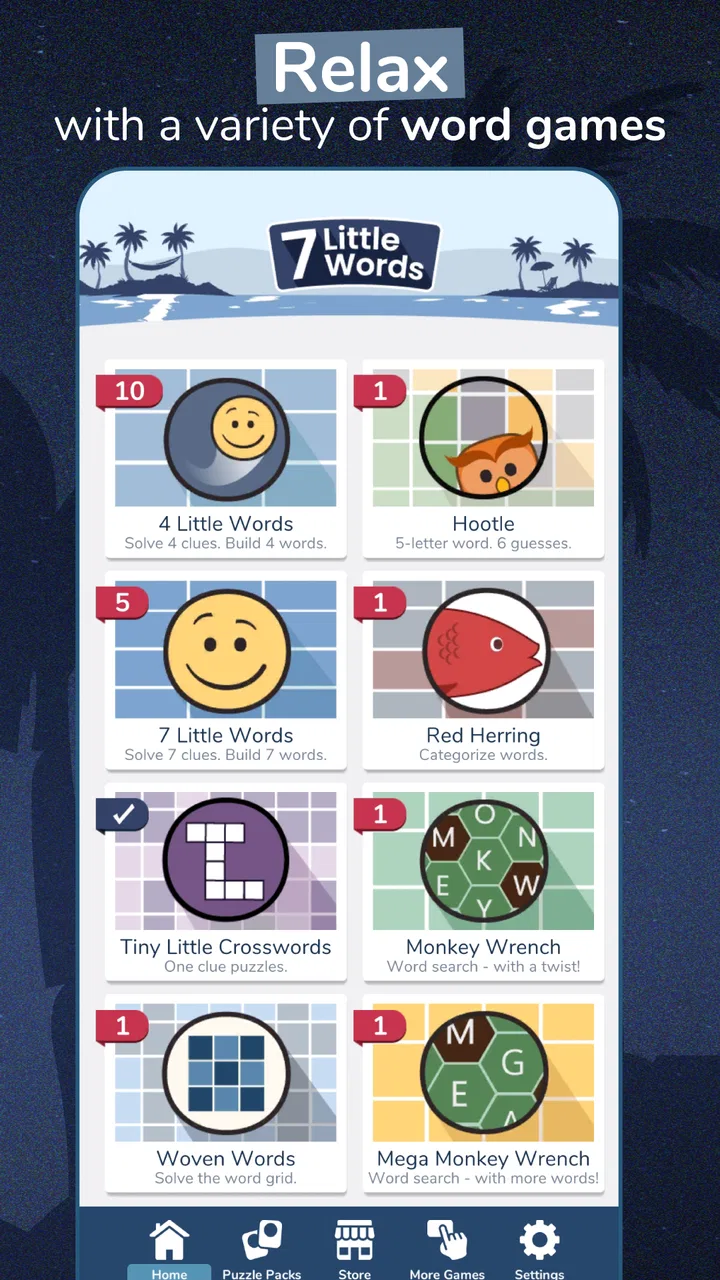
7 Little Words and More is a word-puzzle game built around short, clue-based challenges. Instead of filling a traditional crossword grid, you solve clues by combining groups of letters to form the required answers. The game includes a broad selection of puzzles and additional word-game formats, making it suitable for quick sessions or longer play when you want to test your vocabulary and deduction skills.
02How does the gameplay work in 7 Little Words and More?
Each puzzle presents a set of clues alongside several groups of letters. Your task is to identify the answers and combine the correct letter groups in the right order. The clues can range from straightforward definitions to more challenging word associations, so progress often depends on recognizing prefixes, suffixes, and familiar word patterns. The format is easy to understand but becomes increasingly demanding.
03Can I play 7 Little Words and More without an internet connection?
Many of the available puzzles can generally be played after they have been loaded, which makes the app convenient for travel, commuting, or areas with unreliable connectivity. However, features such as downloading new puzzle content, receiving updates, synchronizing progress, or accessing certain daily challenges may require an internet connection. Availability can also vary depending on the version installed and the device platform.
04Is 7 Little Words and More free to download?
The app is typically available to download at no initial cost, allowing users to try its core puzzle experience before deciding whether they want additional content. Depending on the edition and platform, it may include advertising, optional purchases, subscriptions, or premium puzzle packs. It is worth checking the store listing carefully because pricing, trial periods, and included features may change over time.
05Is 7 Little Words and More suitable for beginners and children?
The simple letter-group system makes 7 Little Words and More approachable for beginners, especially players who enjoy vocabulary games but do not want a complicated interface. Nevertheless, some clues use advanced words, general knowledge, or wordplay that may be difficult for younger players. Parents should review the store’s age rating and consider whether advertisements or optional purchases are appropriate for their child.
Pros
- Short daily puzzles are easy to fit into a busy schedule.
- Clues encourage vocabulary building without feeling like formal study.
- Multiple puzzle formats add variety beyond the main word challenge.
- Hints can help maintain progress when a clue becomes frustrating.
- Clean interface makes the game comfortable for casual players.
Cons
- Some later puzzles may feel difficult without using hints.
- Frequent players may eventually find the puzzle supply repetitive.
- Hints and extra content may be limited by in-app purchases.
- The game offers little appeal if you prefer action or visual gameplay.
- Certain clue answers can feel subjective or unfamiliar.

7 Little Words and More
Gallery